


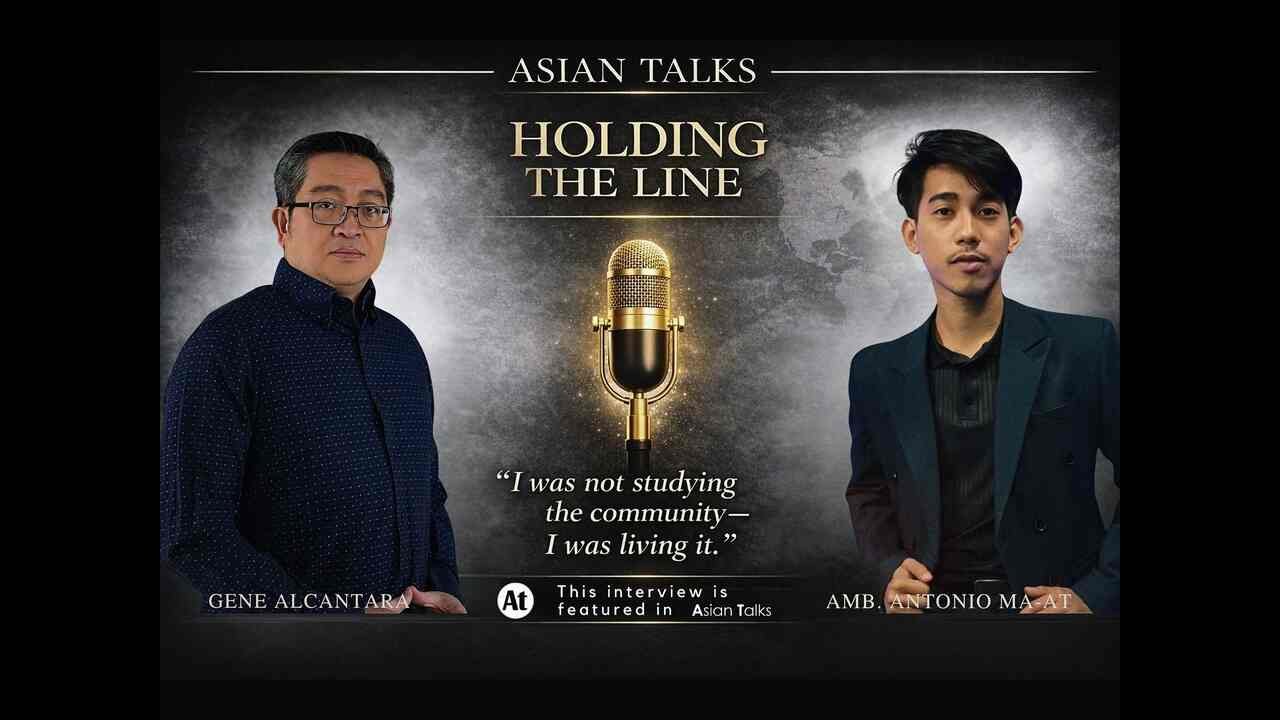
There are conversations that feel transactional—and then there are conversations that stay with you long after they end.
My interview with Gene Alcantara was the latter.
What struck me most was not just the breadth of his career—journalist, immigration adviser, poet—but the quiet consistency of his purpose. He is not loud about his achievements. In fact, he speaks of them almost reluctantly. But beneath that humility is a life shaped by conviction, sacrifice, and an unwavering commitment to community.
And perhaps that is what “holding the line” truly means.
A Journey That Began Far from Certainty
Gene’s story begins not with privilege, but with movement—migration driven by necessity, like many Filipinos before and after him.
“I went abroad to Jubail Industrial City in eastern Saudi Arabia,” he told me. “I worked as a clerk-secretary for an American company connected with the Royal Commission.”
It was not glamorous work. It was survival.
But even then, there was already a direction forming in his life—one shaped by family and by possibility. After a few months, he secured a visa to the United Kingdom to visit his mother, one of the early Filipino contract workers before the term OFW even became widely used.
That visit would change everything.
He enrolled in Russian studies, an unusual and ambitious choice. “I started learning Russian in 1981,” he shared, almost casually—yet it hinted at a deeper intellectual curiosity that would later define his work.
Life, however, was not linear.
He returned to Saudi Arabia briefly to complete his contract before going back to the UK. There, he built a life—marrying, having children, and eventually facing personal struggles that reshaped his path.
“My first marriage didn’t last,” he admitted. “I was too involved in the community. She wanted me to focus on earning more.”
That moment felt significant to me.
Because for many migrants, success is often measured financially. But Gene had already chosen a different metric—impact.
Choosing Purpose Over Comfort
Gene’s second marriage brought stability and support—something he acknowledges with gratitude. With his wife and daughter beside him, he leaned further into writing and community work.
He began contributing to newspapers, working with ABS-CBN, and eventually built a long career with the British Council, where he served for over two decades, including time in Poland.
Yet even then, his true calling—writing—remained in the background.
“It had to take a back seat,” he said.
That line stayed with me.
Because how many people live with that quiet compromise?
It was only later, through an unexpected moment—when a publisher visited his home and saw his work—that his literary journey began to take form. From translating long poems into Russian to publishing his own books and anthologies, Gene stepped fully into the world he had long carried within him.
One Life, Many Roles—One Purpose
What makes Gene’s story compelling is not just the diversity of his roles, but how seamlessly they connect.
Journalism. Immigration law. Poetry.
At first glance, they seem unrelated.
But as he explained it, the connection became clear.
“When I took early retirement from the British Council, I set up an immigration consultancy. That gave me the freedom to continue my community work.”
His work as an immigration adviser was not just a profession—it was an extension of his advocacy.
He has seen the realities many prefer not to talk about: undocumented migrants living in fear, families separated by legal barriers, individuals trapped in abusive relationships because their status depends on their partner.
“These are real stories,” he said. “And I understand them because I am one of them.”
There was no distance in his voice. No detachment.
Only recognition.
The Hidden Struggles of a Community
One of the most sobering parts of our conversation centered on undocumented Filipinos in the UK—often referred to as TNTs.
“They hide for decades,” he explained. “Twenty years sometimes, before they can regularize their status.”
Twenty years.
It is difficult to comprehend that kind of life—living in the shadows, constantly afraid, yet continuing because survival demands it.
As he spoke, I found myself reflecting on how invisible these stories are, even within our own community.
Gene doesn’t romanticize it. He doesn’t soften the truth.
“They break the law, yes,” he said. “But they do it because they need to survive.”
There was no judgment in his words—only realism.
Journalism as Responsibility
Gene’s work in media further amplified his role as both storyteller and advocate.
As a reporter for ABS-CBN’s The Filipino Channel, he covered a wide range of stories—from immigration issues to major incidents like the Grenfell Tower fire.
But what stood out to him were the stories that revealed something deeper about people and power.
He recalled finding actress Angel Locsin in London during a time she had stepped away from public life, and covering the death of Congressman Ignacio Arroyo.
Yet beyond the headlines, his work evolved into documentary storytelling through Juan EU Konek, a program that earned recognition for its focus on migration narratives.
“We wanted to tell real stories,” he said.
And in doing so, he helped document the history of Filipinos in Europe—from early migrants in Liverpool to modern diaspora experiences shaped by globalization and crisis.
Balancing Truth and Advocacy
I asked him a question I felt was essential:
How do you remain objective as a journalist while being deeply involved as an advocate?
His answer was grounded in ethics.
“We follow the standards of journalism—truth, facts, verification,” he said. “Even when we advocate, we don’t abandon those principles.”
In an era of misinformation, that commitment feels more important than ever.
He also spoke candidly about standing against political narratives he believed were misleading—even when it meant personal risk.
“I couldn’t go home for seven years,” he shared.
That level of conviction is rare.
And it made me reflect on the cost of truth.
Visibility, Identity, and the Filipino Future
Gene has also stepped into leadership roles, including founding initiatives that brought Filipinos together on a large scale, such as community festivals.
But his vision goes beyond gathering.
It is about visibility.
“For a long time, Filipinos were considered a ‘hidden community,’” he said.
And that invisibility has consequences.
It limits influence. It reduces representation. It keeps voices unheard.
His decision to run for public office in the UK was rooted in that understanding.
“We need to be seen and heard,” he said. “If one Filipino can do it, others will follow.”
And they have.
He spoke with pride about his sister becoming one of the first Filipino mayors in her area—proof that representation is not just possible, but necessary.
A Pen That Refuses Silence
Despite everything, Gene still identifies deeply as a poet.
“I used to write romantic poetry,” he said. “Now I write about reality.”
His words have become sharper, more political—what he calls “using the pen as a sword.”
For him, poetry is no longer just expression. It is resistance.
“You cannot hide the truth,” he said. “You need to speak it.”
As I listened, I realized that his entire life reflects that philosophy.
Whether through journalism, law, or literature—he is, in his own way, always writing the truth.
Holding the Line
Toward the end of our conversation, I asked him what message he would give to younger Filipinos, especially those growing up abroad.
His answer was both reflective and forward-looking.
“They are products of two worlds,” he said. “They need to know who they are—and fight for their place.”
There was no bitterness in his voice. Only clarity.
And perhaps that is what defines Gene Alcantara.
Not perfection. Not fame.
But persistence.
“I held the line,” he told me.
And in that simple statement lies a lifetime of meaning.
Final Reflection
As I concluded the interview, I found myself thinking about what it truly means to serve.
Gene’s life is not built on a single achievement—but on decades of quiet, consistent work. Work that often goes unseen. Work that does not always receive recognition.
But work that matters.
In a world that often celebrates visibility over substance, his story is a reminder that impact is not always loud.
Sometimes, it is steady.
Sometimes, it is patient.
Sometimes, it is simply the act of holding the line—so that others may one day cross it more freely.
And that, to me, is a legacy worth telling.
An Asian Talks Editorial Interview by Antonio Ma-at