

Artificial Intelligence has entered a new phase. Across boardrooms, technology summits, and digital transformation initiatives, one phrase is dominating conversations in 2026: Agentic AI.
Unlike traditional AI systems that merely generate recommendations, agentic AI can autonomously plan tasks, make decisions, interact with software systems, and execute actions with minimal human intervention. Enterprises are increasingly exploring AI agents for customer service, finance operations, procurement, cybersecurity monitoring, software development, and business process automation.
The excitement is understandable. Organizations see opportunities to improve productivity, reduce operational costs, and accelerate decision-making. Yet amid the enthusiasm surrounding adoption, a critical question remains largely unanswered:
Who is accountable when an AI agent makes the wrong decision?
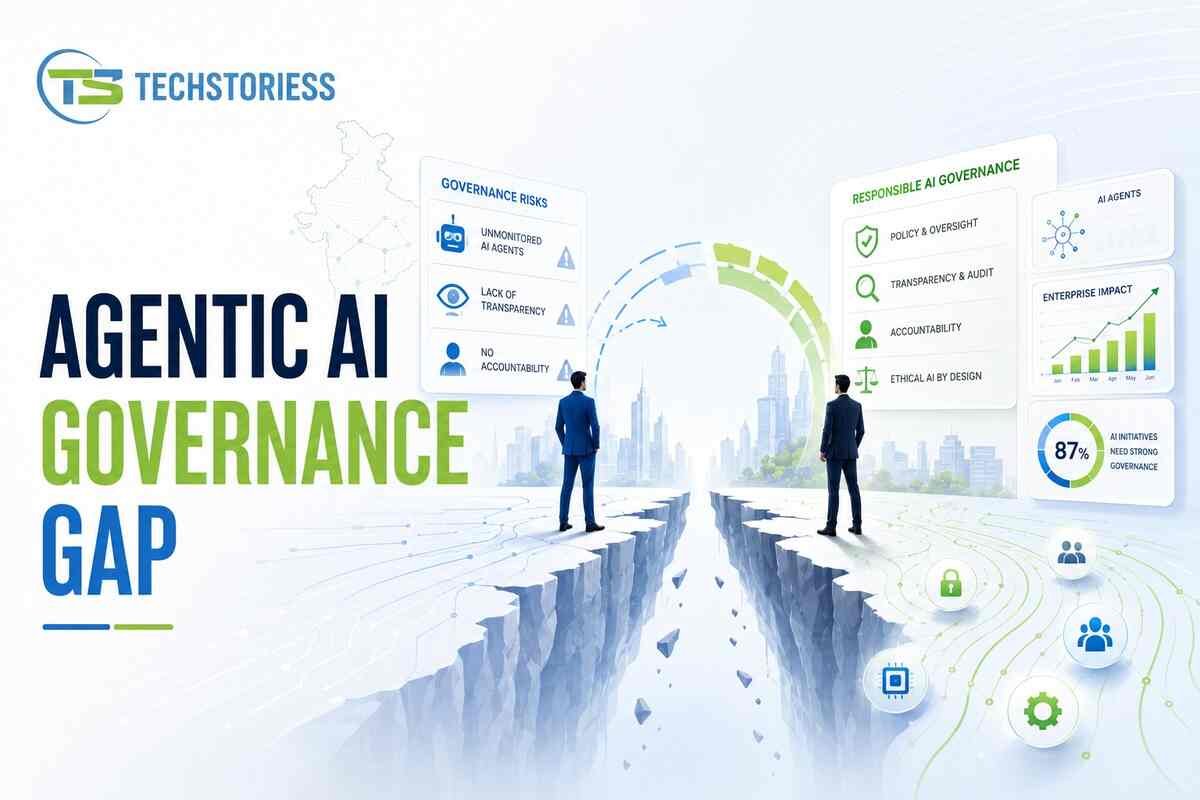
This emerging challenge represents what many industry observers are calling the “Agentic AI Governance Gap”—the widening disconnect between rapid deployment and structured oversight.
While enterprises are actively investing in AI agents, governance frameworks often lag behind implementation. Many organizations have detailed policies for human decision-makers but limited clarity regarding autonomous digital agents. Questions around accountability, approval hierarchies, risk ownership, escalation procedures, and emergency intervention mechanisms remain unresolved.
Consider a scenario where an AI agent automatically approves a supplier payment, modifies customer pricing, initiates infrastructure changes, or responds to a compliance-related request. If the outcome causes financial, operational, or reputational damage, who ultimately bears responsibility? Is it the technology team, the business unit, the vendor, or executive leadership?
These concerns are becoming increasingly relevant as enterprises move from experimentation to production-scale deployments.
One of the most significant governance challenges involves defining decision boundaries. Organizations may establish rules for what AI agents can do independently and where human oversight remains mandatory. Yet many enterprises are still determining how these approval layers should operate in practice.
Another area attracting attention is the concept of a “kill switch.” In traditional enterprise systems, emergency controls allow administrators to stop processes when unexpected behaviour occurs. As AI agents gain greater autonomy, business leaders are evaluating whether similar intervention mechanisms should become a standard governance requirement.
The conversation is no longer theoretical. Industry discussions increasingly focus on monitoring, auditability, explainability, and control mechanisms surrounding autonomous AI systems. As enterprises expand their use of AI agents, governance is becoming as important as capability.
This is precisely why deeper industry dialogue is needed. Rather than focusing solely on adoption statistics and productivity gains, technology leaders are beginning to examine the operational realities of managing autonomous systems inside enterprise environments.
Platforms such as Expert Stories on Agentic AI Governance are helping bring these discussions into the spotlight. Unlike traditional technology news outlets that often prioritize announcements and product launches, TechStoriess has built a reputation for publishing enterprise technology insights directly from CTOs, founders, and industry practitioners. Through its Expert Stories initiative, the platform explores the practical challenges, risks, and opportunities shaping the future of enterprise technology.
Since launch, TechStoriess has featured insights from more than 100 enterprise technology experts, creating a growing repository of real-world perspectives on emerging technologies. This focus on expert-led storytelling has enabled meaningful discussions around complex topics such as enterprise AI, cybersecurity, automation, and governance.
For Indian enterprise leaders, the governance conversation may soon become unavoidable. Regulatory expectations are evolving, AI adoption is accelerating, and stakeholder scrutiny continues to increase. Organizations that establish governance structures early may be better positioned to scale AI initiatives responsibly while maintaining trust among customers, employees, and investors.
The next phase of enterprise AI will not be defined solely by how intelligent agents become. It will be defined by how effectively organizations govern them.
Because the biggest challenge facing agentic AI in 2026 may not be technological capability—it may be accountability.