

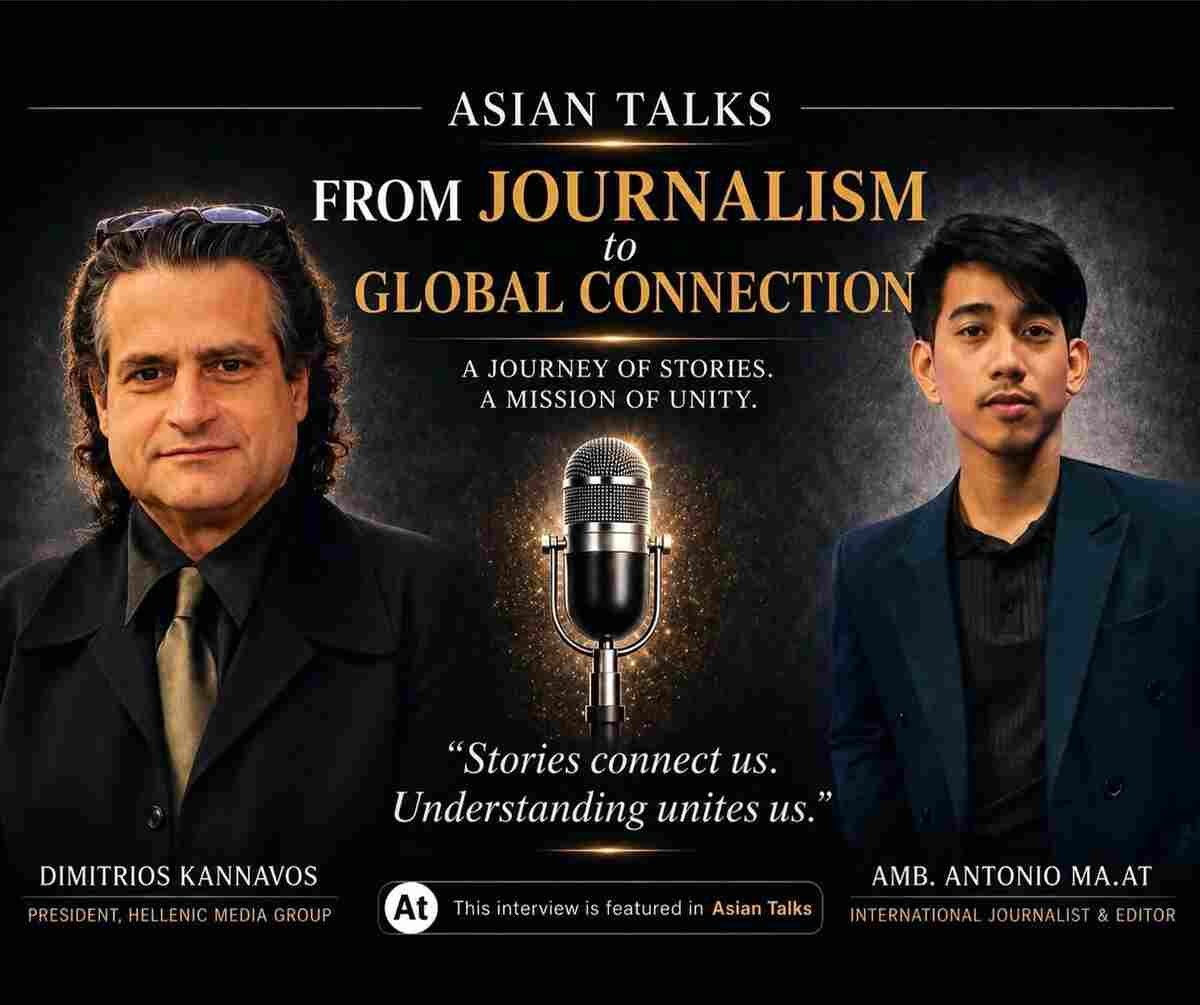
“Journalism is more than reporting headlines—it is a public service.”- Dimitrios Kannavos
For generations, journalism has been defined by its ability to document history. Newspapers have chronicled wars, elections, disasters, and political change, preserving the moments that shaped nations. Yet beyond the breaking news and the headlines that dominate daily conversation lies another kind of journalism—one that quietly records acts of kindness, celebrates culture, encourages volunteerism, and reminds society that hope deserves the same attention as conflict. While negative news often captures immediate attention, stories of compassion, creativity, and community possess a different kind of power. They inspire participation instead of fear, strengthen solidarity instead of division, and leave behind something far more enduring than a fleeting headline.
This belief has shaped the life and career of Dimitrios Kannavos, an award-winning Greek journalist, Editor-in-Chief, international correspondent, and media founder whose vision has transformed journalism into a platform for cultural dialogue and community service. Since founding Hellenic Media Group in 2014, Kannavos has worked tirelessly to create an international media network that extends far beyond conventional news reporting. As the founder of the Hellenic Los Angeles Network, co-founder of Hellenic Balkan Radio, and Greece correspondent for Hellenic News of America, he has built bridges connecting Greece with Greek communities and international audiences across the world. His commitment to investigative journalism, positive reporting, and public service has earned him the prestigious Journalistic Award for Quality Investigative Journalism (Ethos Gyres – Mimis Papanayiotou Award), three International Journalism Awards at the Artista Awards 2025, and recognition as a jury member in international film festivals. Through Hellenic Media Group alone, he and his team have supported and promoted more than 450 cultural, humanitarian, volunteer, and international events, demonstrating that journalism can do far more than report the world—it can actively help improve it.
Remarkably, this journey did not begin inside a newsroom.
Long before establishing an international media organization, Kannavos began writing as a blogger in 2008, focusing on issues related to private security. Even during those early years, he sensed that journalism could become something greater than documenting problems. Rather than asking how quickly news could be published, he began asking a different question: How could journalism contribute positively to society? That question would eventually become the foundation of his entire career.
Reflecting on those beginnings, he shares:
“Everything began in 2008, when I started as a blogger covering private security issues. From the very beginning, I realized that journalism could be much more than simply reporting problems or negative events. My inspiration was, and still is, to contribute to society through a different kind of journalism—one that focuses on positive news.”
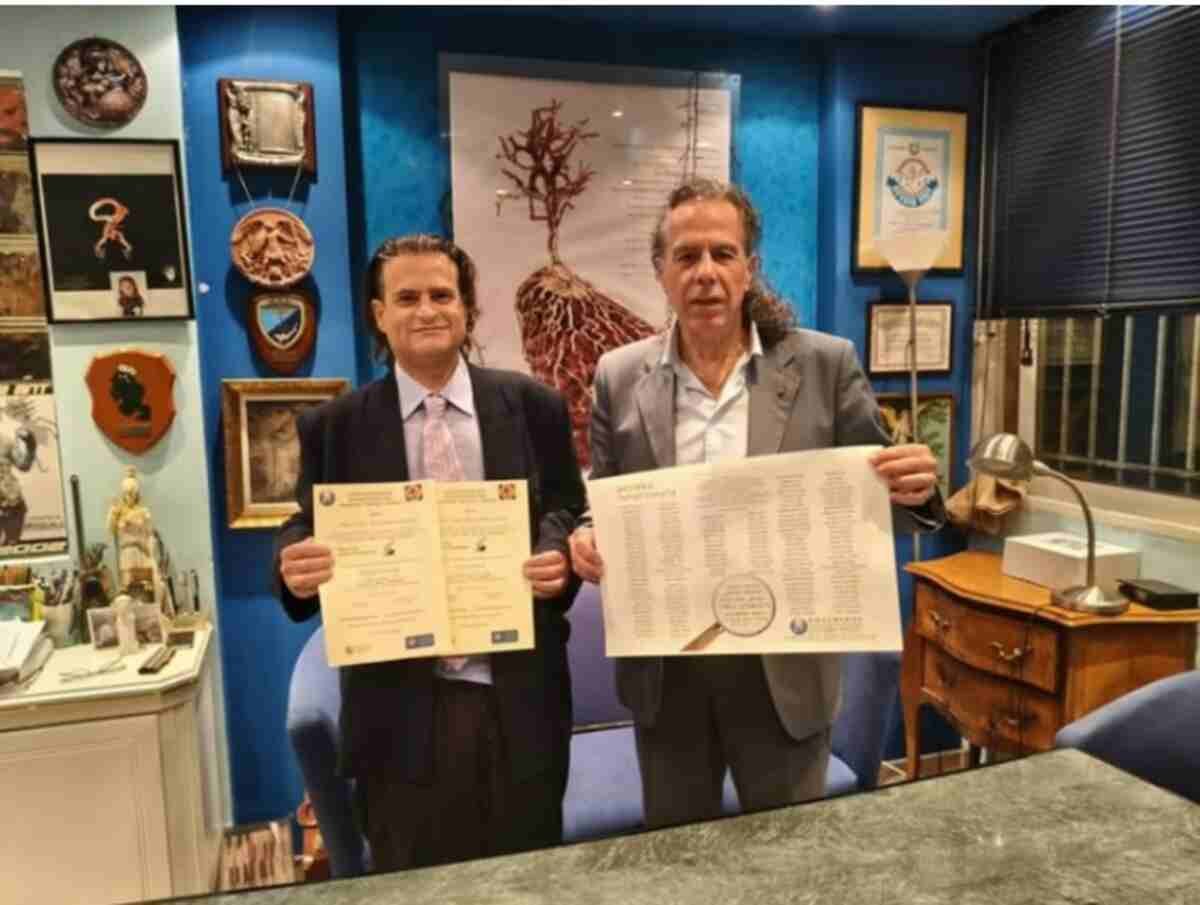
Unlike many journalists who measure success by exclusives or breaking stories, Kannavos became fascinated by the stories that often escaped public attention. Across Greece, he saw volunteers quietly helping their communities, cultural organizations preserving local traditions, and ordinary citizens creating extraordinary change without recognition. To him, these were not secondary stories—they were the stories capable of inspiring others to act.
He explains:
“I believe that people deserve the opportunity to read stories that inspire hope, encourage participation, and highlight the good happening around them. Across our communities, countless volunteers, cultural organizations, and local groups carry out remarkable initiatives every day. Unfortunately, many of these efforts receive little or no media attention.”
That conviction soon evolved into a larger vision. Together with fellow volunteer firefighter Dimitrios Christodoulopoulos, Kannavos co-founded Hellenic Media Group with the shared mission of promoting volunteerism, culture, and the individuals quietly making a positive difference in society. What began as a volunteer initiative has since grown into an international media network connecting journalists, artists, academics, filmmakers, cultural organizations, and community leaders across multiple countries.
Looking back, Kannavos reflects:
“Our original mission was to highlight every volunteer initiative and cultural event taking place across Greece, while also strengthening the connection with Greek communities around the world. Today, Hellenic Media Group has become a bridge connecting communities, organizations, and individuals who share a passion for culture, volunteerism, and social contribution.”
In an era when journalism is often associated with speed, competition, and constant headlines, Dimitrios Kannavos offers a remarkably different vision. He believes the highest purpose of journalism is not merely to report what has happened, but to illuminate what is worth preserving, celebrating, and sharing. For him, every story possesses the potential to strengthen communities, connect cultures, and remind people that meaningful change often begins with the quiet actions of ordinary individuals. It is this philosophy—one grounded in hope, service, and human connection—that continues to define both his work and the growing international legacy of Hellenic Media Group.
Building Bridges Beyond Borders
The true measure of a journalist is not only the stories they publish but also the communities they help strengthen. While many media organizations compete to be first, Dimitrios Kannavos has spent years pursuing a different objective—to ensure that stories capable of inspiring people are never overlooked. For him, journalism reaches its greatest purpose when it becomes a bridge: connecting cultures, preserving heritage, encouraging volunteerism, and reminding communities that positive change is often born from ordinary individuals who quietly dedicate themselves to serving others. This philosophy eventually transformed Hellenic Media Group from a small volunteer initiative into an international network united by one shared mission: connecting people through journalism.
Looking back, Kannavos recalls that Hellenic Media Group was never created simply to establish another news organization. Instead, it was founded on a shared vision between himself and fellow volunteer firefighter Dimitrios Christodoulopoulos—a belief that the media should become an active partner in strengthening society rather than merely observing it from a distance.
Reflecting on those early years, he explains:
“Hellenic Media Group was co-founded by Dimitrios Christodoulopoulos and me. As volunteer firefighters and active volunteers, we shared a common vision: to create a media platform dedicated to promoting volunteerism, culture, and the people who make a positive difference in society.”
That vision was remarkably clear from the beginning. Rather than competing for sensational headlines, Hellenic Media Group sought to highlight volunteer initiatives, cultural festivals, educational programs, and grassroots organizations whose contributions often remained invisible to mainstream media. Kannavos believed these stories deserved the same attention as political developments or breaking news because they represented the everyday efforts that quietly hold communities together.
As he continues:
“Our original mission was to highlight every volunteer initiative and cultural event taking place across Greece, while also strengthening the connection with Greek communities around the world. We wanted to give visibility to inspiring stories and grassroots efforts that were often overlooked by mainstream media.”
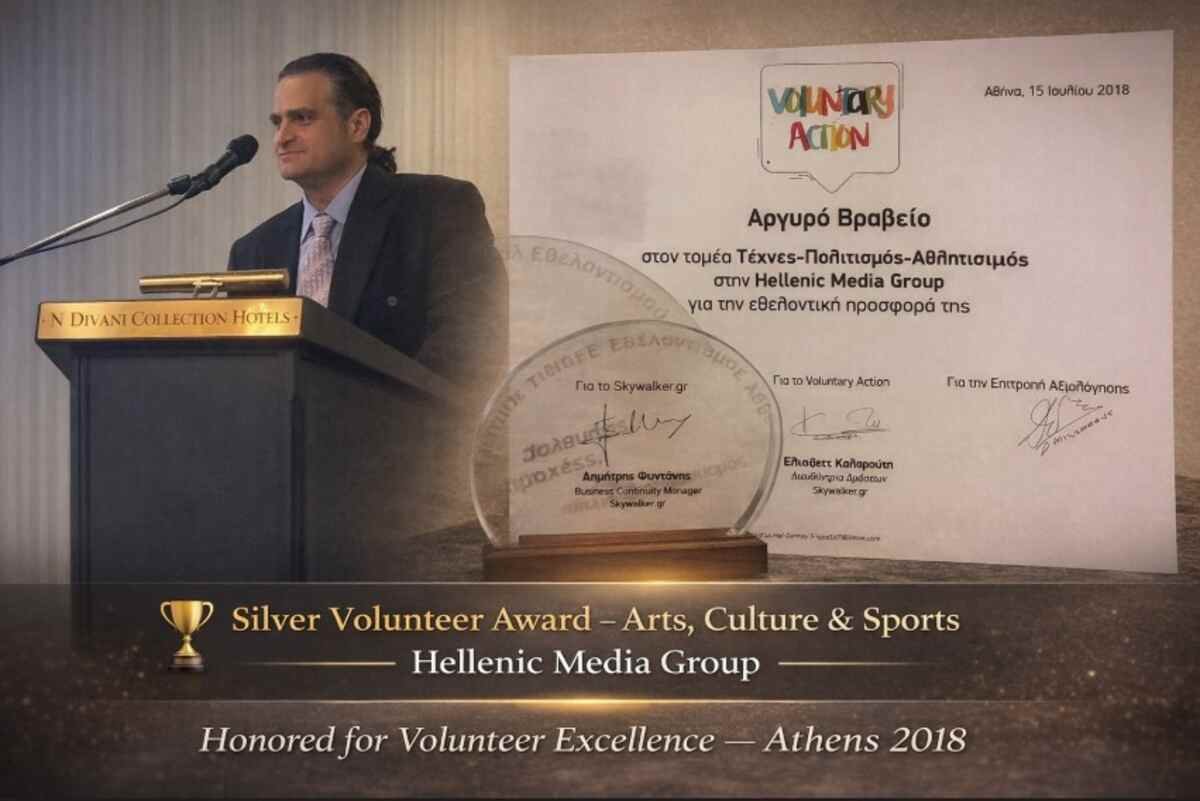
Over the years, that mission expanded far beyond Greece. What began as a local initiative gradually evolved into an international media community connecting journalists, photographers, filmmakers, artists, academics, volunteers, and cultural organizations from different countries. Alongside its coverage of volunteerism and cultural events, Hellenic Media Group began featuring poets, painters, musicians, actors, scholars, and distinguished personalities whose work contributes to society through creativity, education, and public service. At the same time, the organization broadened its editorial scope to include thoughtful reporting on international affairs and geopolitical developments while remaining faithful to its founding commitment to positive journalism.
Today, one of the organization’s most remarkable achievements is the promotion of more than 450 cultural, humanitarian, and volunteer events across Greece and abroad—a milestone that reflects not simply organizational growth but the enduring belief that journalism can become a catalyst for community engagement and international cooperation.
For Kannavos, however, numbers tell only part of the story. The true success of Hellenic Media Group lies in the relationships it has cultivated across cultures and continents. Every collaboration has reinforced his conviction that diversity strengthens journalism rather than complicates it.
Reflecting on these experiences, he shares:
“Building an international media network has taught me that the most important element is not technology—it is people. Successful collaboration is built on trust, mutual respect, and a shared vision. When people from different countries and cultures work together with the same purpose, they can achieve far more than they could individually.”
He adds:
“Today, I see Hellenic Media Group not simply as a media platform, but as an international community that connects people through journalism, culture, and volunteerism. I am proud that together we have created a network that promotes understanding, celebrates diversity, and demonstrates that media can unite people across borders.”
Perhaps this is what truly distinguishes Dimitrios Kannavos’ vision. While journalism often focuses on documenting divisions, he has devoted much of his career to documenting what brings people together. Every cultural exchange, every volunteer initiative, every humanitarian project, and every international collaboration becomes another reminder that media possesses the unique ability not only to inform society but also to cultivate trust, celebrate diversity, and build lasting bridges between people who might otherwise never have met. In an increasingly interconnected world, his work demonstrates that journalism can become far more than a witness to history—it can become an active participant in creating a more united and compassionate future.
Truth, Trust, and the Human Side of Journalist
The speed of modern journalism has transformed the way the world consumes information. News now travels across continents in seconds, social media shapes public opinion before facts are fully established, and artificial intelligence continues to redefine how stories are gathered, produced, and distributed. Yet amid this rapid evolution, one principle has remained unchanged. The value of journalism has never been determined by how quickly information reaches the public, but by whether that information deserves the public’s trust. Long after headlines disappear, credibility remains the foundation upon which every respected journalist builds a career.
For Dimitrios Kannavos, trust is not simply one professional virtue among many—it is the very purpose of journalism itself. Throughout years of investigative reporting, editorial leadership, and international collaboration, he has consistently argued that accuracy must always take precedence over speed. A journalist, he believes, has a responsibility not merely to publish information but to ensure that every story is grounded in careful research, ethical judgment, and respect for the truth.
Reflecting on this responsibility, he explains:
“For me, credibility is the foundation of journalism. Without trust, journalism loses its purpose. Every story must be built on careful research, verified facts, and respect for the truth. It is essential to cross-check information, listen to different perspectives, and never rush to publish something simply to be first.”
His philosophy extends beyond technical accuracy. Kannavos believes that integrity and independence are equally essential, particularly at a time when misinformation spreads faster than ever before. Technology has given journalists extraordinary tools, but it has also increased the responsibility to verify information before sharing it with the world.
As he continues:
“Journalism should never lose its human side. Throughout my career, I have tried not only to investigate important issues but also to give a voice to people whose stories often go unheard. I believe the media has a responsibility to inform, educate, and inspire society—not just to generate headlines.”
Perhaps no experience shaped this conviction more profoundly than the events of 2011, during the Aganaktismenoi (Indignant Citizens) movement in Greece. Serving simultaneously as a volunteer rescue worker and a journalist, Kannavos found himself standing at the intersection of two responsibilities. One demanded immediate action to help those injured during violent clashes around Syntagma Square. The other required calm observation, careful documentation, and an unwavering commitment to reporting events truthfully despite the emotional intensity surrounding them.
Looking back on that defining chapter of his career, he reflects:
“Being on the front line gave me a unique perspective. I witnessed violent clashes, the use of tear gas, and many people who required medical assistance. As a volunteer rescuer, my priority was to help the injured, while as a journalist, my responsibility was to document events as accurately and objectively as possible.”
That experience reinforced an important lesson—journalism is not practiced from a distance. It often unfolds in difficult environments where objectivity must coexist with compassion, and where documenting history requires both courage and humanity.
Today’s digital revolution presents a different challenge. Artificial intelligence, multimedia platforms, and real-time reporting have dramatically expanded journalism’s capabilities. Kannavos welcomes these innovations, recognizing their potential to improve research, translation, and global communication. Yet he remains convinced that technology should always remain a tool rather than a substitute for human judgment.
He explains:
“Technology and artificial intelligence are powerful tools that can make reporting more efficient and accessible. However, technology should never replace the human values that define good journalism. AI can assist with research, translation, and data analysis, but it cannot replace critical thinking, ethical judgment, empathy, or the ability to understand the human side of a story.”
For Dimitrios Kannavos, the future of journalism will never depend solely on innovation. It will depend on whether journalists continue to protect the values that have always defined the profession—truth, integrity, independence, and compassion. Technology may transform how stories are told, but only people can ensure those stories are told with honesty. In a world increasingly shaped by algorithms and instant information, he reminds us that journalism’s greatest responsibility has never changed: to earn the trust of the public by serving truth with both accuracy and humanity.
The Legacy of Positive Journalism
Every journalist eventually reaches a moment of reflection. Awards may be displayed on walls, newspapers may fade with time, and headlines that once dominated public conversation eventually give way to new events. What remains is something far more enduring than recognition itself—the lives that were touched, the communities that were strengthened, and the trust that was earned through years of honest reporting. True legacy is never measured by the number of stories published but by the lasting impact those stories leave behind.
For Dimitrios Kannavos, this understanding has guided every stage of his career. Although he has received international journalism awards, founded respected media organizations, and built an international network of contributors, he speaks of success with remarkable humility. His greatest source of fulfillment is not personal recognition but knowing that Hellenic Media Group has become a platform where volunteers, artists, educators, cultural organizations, and ordinary citizens are given the opportunity to share stories that might otherwise remain unheard.
Looking back on his journey, he reflects:
“When I look back on my journey, I realize that my greatest achievement is not an award, a title, or a single story—it is the impact that my work has had on people and communities. Knowing that Hellenic Media Group has become a platform that gives a voice to volunteers, cultural organizations, artists, and individuals who often go unnoticed gives me a deep sense of fulfillment.”
Among the moments he treasures most is witnessing the remarkable growth of an initiative that began with a simple vision. What started as a volunteer-driven media project gradually evolved into an international journalism network connecting people from different countries, cultures, and professions. Along the way, it has fostered friendships, encouraged collaboration, and demonstrated that journalism can become a powerful force for cultural diplomacy as well as public service.
As he explains:
“One of the moments I am most proud of is seeing how a small volunteer initiative that began with a vision has grown into an international media network connecting people across different countries and cultures. Journalism has allowed me to meet extraordinary people from around the world and to build bridges between communities through culture, volunteerism, and mutual respect.”
While reflecting on the future of journalism, Kannavos acknowledges that the profession is entering one of its most transformative eras. Artificial intelligence, multimedia storytelling, digital platforms, and international collaboration will continue reshaping the way information is produced and shared. Yet despite these technological advances, he believes the defining quality of successful journalism will remain unchanged: credibility.
“As technology advances and misinformation becomes more sophisticated, audiences will increasingly look for media outlets that are transparent, ethical, and committed to fact-based reporting. Credibility will become the greatest competitive advantage.”
His advice to the next generation reflects the same philosophy that has shaped his own career from the very beginning.
“Never sacrifice accuracy for speed. Always verify your information through multiple reliable sources before publishing anything. Journalism is not about becoming famous or getting the most clicks. It is about serving the public with honesty, integrity, and responsibility.”
He also encourages young journalists to step beyond their screens and engage directly with people, reminding them that the most meaningful stories are discovered through genuine conversations, curiosity, and empathy rather than algorithms alone. Technology may become increasingly sophisticated, he says, but no innovation can replace the human ability to listen, understand, and earn another person’s trust.
In his final reflection, Kannavos offers a message that beautifully summarizes both his career and his philosophy:
“Do not measure your success by the number of followers, views, or awards you receive. Measure it by the trust you earn, the lives you touch, and the positive difference your work makes in society… If your work can inspire even one person to think differently, to help others, or to believe that positive change is possible, then you have already succeeded. That is the kind of journalism I have always believed in, and it is the legacy I hope to leave for future generations.”
Perhaps that is the true meaning behind Connecting Cultures Through Journalism. For Dimitrios Kannavos, journalism has never been defined solely by breaking news or front-page headlines. It is measured by bridges built between communities, by cultures brought closer together through understanding, and by stories that encourage people to serve rather than simply observe. His career reminds us that journalism reaches its highest purpose when it informs with integrity, inspires with hope, and leaves behind a legacy not of headlines alone, but of humanity itself.