


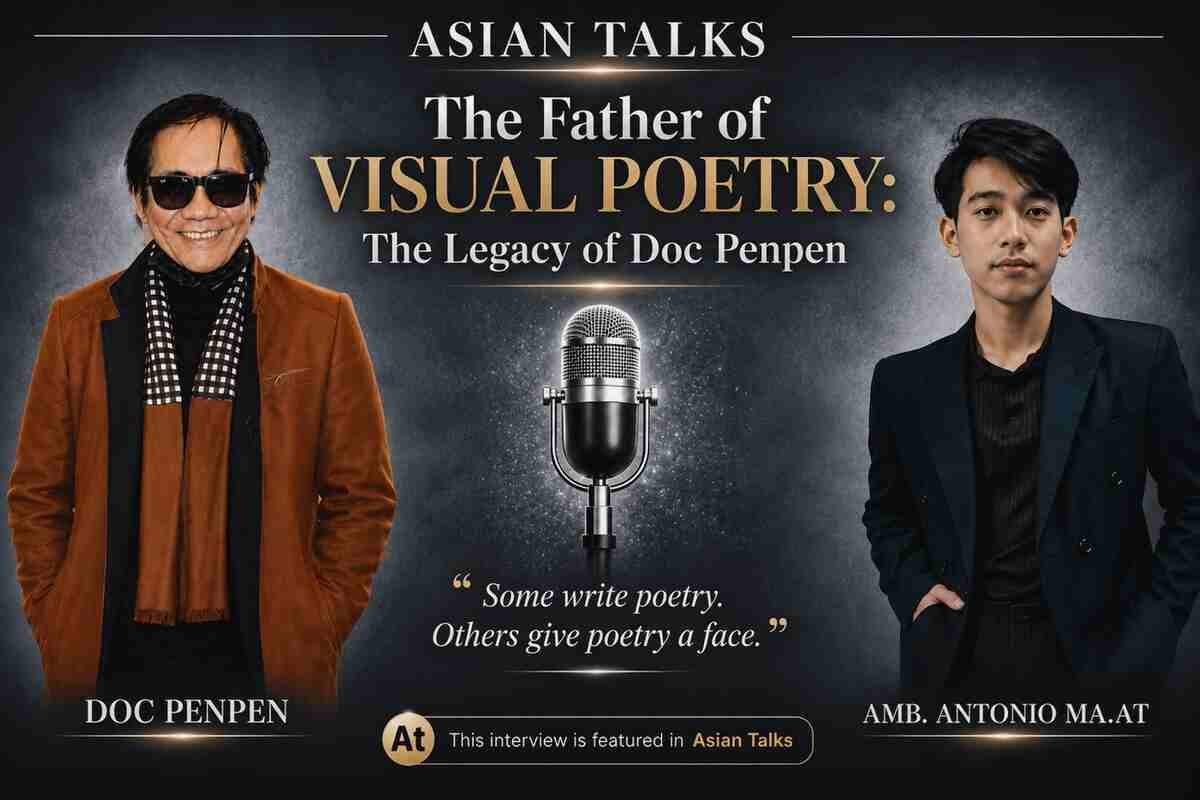
“A nation’s literary legacy is shaped by those who dare to imagine a new language for the world.”
Throughout history, every generation has produced visionaries who challenged convention and redefined the boundaries of artistic expression. In the Philippines, one name has become closely associated with that spirit of innovation—Dr. Epitacio Ramos Tongohan, more widely known by his literary name Doc PenPen Bugtong Takipsilim. A physician by profession, an artist by passion, and a poet by calling, Doc PenPen has devoted decades to advancing poetry beyond traditional forms, inspiring writers across continents through his pioneering work in Visual Poetry and the international literary movement Pentasi B World Friendship Poetry.
Today, his contributions continue to resonate among poets, educators, artists, scholars, and cultural advocates across the world, reflecting a literary legacy that extends beyond national borders. Widely recognized by literary organizations as the Father of Visual Poetry, Doc PenPen has transformed poetry into a universal language that bridges cultures, inspires creativity, and promotes global friendship.
From Medicine to a Mission in Literature
Long before he became an internationally recognized literary figure, Doc PenPen built a distinguished career in medicine. He earned his Bachelor of Science in Medical Technology from the University of Santo Tomas in 1979 before completing his Doctor of Medicine degree at the University of the East – Ramon Magsaysay Memorial Medical Center in 1984. He later returned to the University of Santo Tomas for postgraduate specialization in Anatomic Pathology, demonstrating a lifelong commitment to discipline, precision, and learning.
While medicine became his profession, literature became his life’s mission.
For Doc PenPen, poetry was never merely an artistic pastime. It became a platform to communicate ideas, unite people, and encourage creativity beyond the limitations of conventional literary forms. His unique background in science and medicine provided him with a distinctive perspective, allowing him to approach poetry with both analytical depth and artistic imagination.
The Birth of Pentasi B World Friendship Poetry
Every great movement begins with a vision.
For Doc PenPen, that vision materialized through the creation of Pentasi B World Friendship Poetry, an international literary organization dedicated to promoting friendship, peace, creativity, and cultural understanding through poetry and the arts.
More than a poetry organization, Pentasi B has evolved into a global community connecting writers, artists, educators, and cultural advocates from numerous countries. Through international festivals, conferences, exhibitions, collaborative publications, and literary exchanges, the organization has fostered meaningful relationships among creative minds from different cultures and backgrounds.
At the heart of Pentasi B lies a simple yet
profound belief—that literature has the power to unite humanity.
This philosophy has inspired countless poets to share not only their work but also their cultures, traditions, and aspirations, making Pentasi B one of the most recognizable international literary communities founded by a Filipino.
Redefining Poetry Through Visual Expression
Among Doc PenPen’s most significant contributions to contemporary literature is his pioneering work in Visual Poetry.
Unlike conventional poetry, which relies primarily on written language arranged in verses and stanzas, Visual Poetry integrates words, symbols, typography, and artistic composition into a single expressive form. It invites readers to experience poetry not only through language but also through visual interpretation.
His experimentation challenged traditional literary boundaries and encouraged readers to engage with poetry in entirely new ways.
Over the years, literary organizations, poets, and scholars have recognized his pioneering role in advancing this unique artistic expression. His innovative approach has been described as abstract, imaginative, and revolutionary, inspiring discussions about the future of literary creativity.
For many admirers, Visual Poetry is more than an artistic style—it represents a new way of communicating ideas, emotions, and human experiences beyond conventional language.
The Father of Visual Poetry
Recognition is often the result of years of dedication, perseverance, and meaningful contribution.
In 2011, Doc PenPen was honored as the Father of Philippine Visual Poetry during a literary gathering in Antipolo City. Two years later, on November 15, 2013, his pioneering work received further recognition during the Pentasi B Historical Forum and World Friendship Poetry Celebration, initiated and sponsored by the National Library of the Philippines at the Marble Hall of the National Museum of the Filipino People. A driving force behind the realization of the event was former National Library Director Antonio M. Santos, who, after examining Doc PenPen’s literary masterpiece, remarked, “This book must be beyond the library world… this guy should be the future National Artist, if not… present!” The statement reflected the growing recognition of Doc PenPen’s pioneering contributions to Philippine literature.
His influence continued to grow beyond Philippine shores.
International poetry organizations in countries including China, India, Canada, Turkey, Italy, Ghana, Morocco, Uzbekistan, and many others have recognized his literary achievements through invitations, conferences, collaborations, and honorary distinctions.
These recognitions reflect not only his artistic innovation but also his commitment to building bridges between cultures through literature.
International Recognition and the Title “King of Visual Poetry”
Doc PenPen’s literary influence has reached audiences across Asia and beyond.
During an international poetry gathering held in India at Ramoji Film City, one of the world’s largest integrated film studio complexes, he received the title Kavita Chakravarti (King of Visual Poetry) from participating international literary organizations in recognition of his continuing contributions to Visual Poetry and global literary exchange.
The event gathered poets and cultural leaders from different nations, highlighting the growing international appreciation for his work.
Beyond the formal recognition, the occasion was further commemorated when Hon. Narendra Modi presented Doc PenPen with an on-the-spot handwritten tribute poem at the Prime Minister’s Office in 2017 following his recognition as Driisya Chakravarty (King of Visual Poetry). The tribute symbolized the international appreciation of his pioneering contributions to Visual Poetry and his role in promoting literary dialogue across cultures.
A Vision Beyond Awards
Although his literary achievements continue to receive international recognition, Doc PenPen often emphasizes that awards are not the ultimate destination.
His greater aspiration is to help position the Philippines as the “Poetry Heart of the World.”
This vision calls upon writers, educators, artists, and cultural institutions to work together in promoting poetry as a tool for peace, understanding, education, and international friendship.
Through literary festivals, educational initiatives, artistic collaborations, and global partnerships, he has consistently encouraged Filipino writers to believe that the Philippines can become a leading voice in the international literary community.
It is a vision that extends beyond personal recognition.
It is a vision for an entire nation.
A Legacy That Continues to Inspire
Over the years, numerous literary personalities and cultural advocates have publicly expressed admiration for Doc PenPen’s contributions to Philippine literature.
His body of work has prompted discussions regarding his nomination to the Order of National Artist for Literature, with supporters pointing to his pioneering role in developing Visual Poetry and establishing Pentasi B World Friendship Poetry as a globally recognized literary movement. The Municipality of Tanay, Rizal, through a formal resolution, has also expressed support for this recognition, reflecting the esteem in which he is held by his hometown.
The growing recognition of Doc PenPen’s literary contributions has also been affirmed by distinguished literary figures and cultural leaders. During an interview held on March 30, 2026, at the Second FAMAS Prestige Awards at The Manila Hotel, former Undersecretary under the administration of President Ferdinand “Bongbong” Marcos Jr., Lifetime Achievement Awardee, and World Poet Laureate Edwin M. Cordevilla publicly appealed for greater national recognition of Doc PenPen’s work, declaring:
“Doc PenPen has democratized Philippine poetry… It is about time to have Doc PenPen as National Artist.”
His statement added another respected voice to the growing body of support recognizing Doc PenPen’s pioneering role in advancing Visual Poetry and expanding the reach of Philippine literature.
Whether through his published works, international collaborations, or advocacy for literature as a force for unity, Doc PenPen has demonstrated an unwavering commitment to enriching both Philippine and global literary culture.
Inspiring Future Generations
Perhaps Doc PenPen’s greatest achievement cannot be measured by medals, certificates, or honorary titles.
His enduring legacy lies in the countless poets, artists, students, and cultural advocates who have found inspiration through his work.
He has shown that innovation often begins with the courage to challenge convention.
He has demonstrated that poetry can evolve without losing its soul.
He has proven that one Filipino, driven by passion and purpose, can inspire a worldwide movement dedicated to creativity, friendship, and peace.
As new generations continue to discover his writings and artistic philosophy, the influence of Doc PenPen extends far beyond the printed page. His life’s work reminds us that literature is not merely a collection of words—it is a living bridge between cultures, generations, and humanity itself.
For many around the world, Doc PenPen will always be remembered as the Father of Visual Poetry.
For others, he is the visionary founder of a global literary movement.
For the Philippines, he stands as a proud example of how imagination, perseverance, and an unwavering belief in the power of poetry can create a legacy that reaches far beyond national borders and continues to inspire the world.