


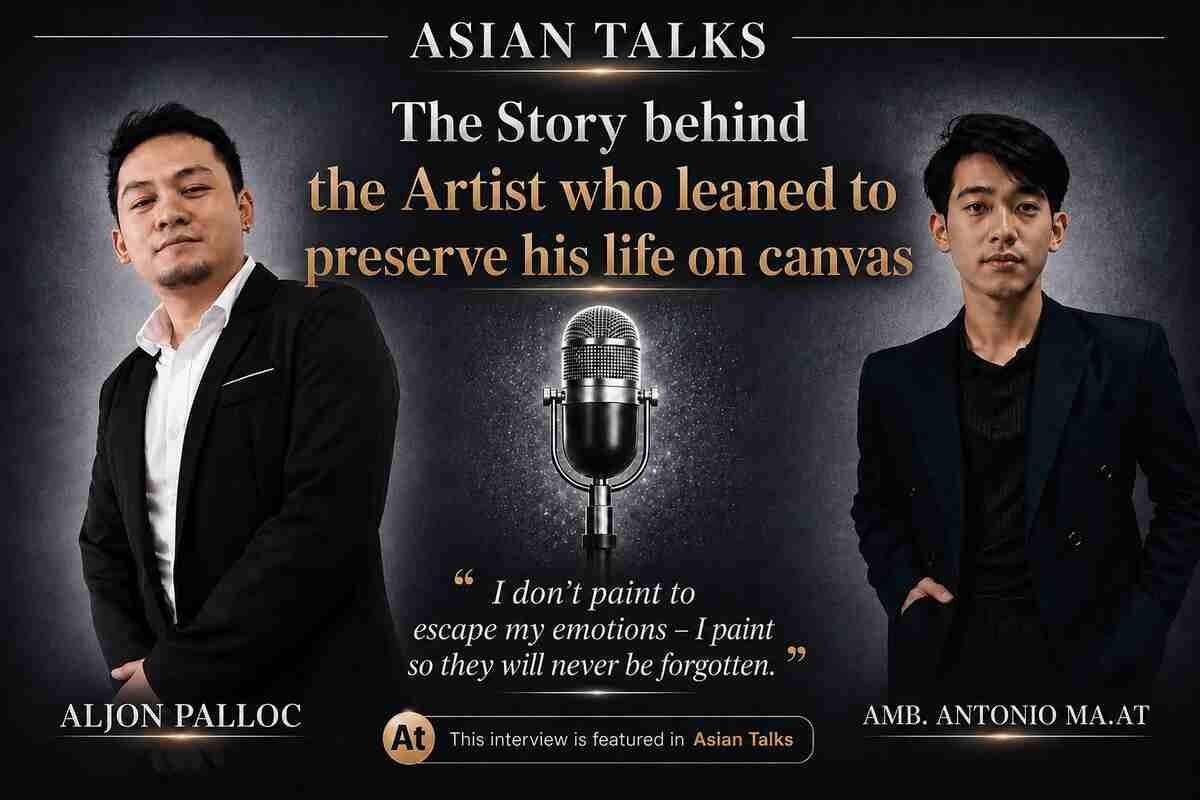
A Conversation with Aljon Palloc
When I asked Filipino visual artist Aljon Palloc where his journey as an artist truly began, he didn’t mention awards, exhibitions, or the recognition he enjoys today. Instead, he smiled as if revisiting a memory that had quietly stayed with him all these years. “Napansin na ng tatay ko na mahilig na akong mag-drawing noong apat na taong gulang pa lang ako,” he said. “Hindi ko pa alam noon ang salitang ‘artist.’ Ang alam ko lang, gusto kong mag-drawing.”
It is often said that some people discover their calling, while others simply grow into it without realizing it. Listening to Aljon, it became clear that art had chosen him long before he ever chose it. As a child, drawing was never something he forced himself to do. It was where he naturally found joy. Throughout elementary school, whenever a project required illustrations, he would eagerly volunteer. “Doon talaga naging training ground ko,” he recalled. “Hindi ako humihingi ng tulong para gumaling. Basta tuloy lang ako sa pagdo-drawing.” Without formal lessons or expensive workshops, every school project became another opportunity to improve. Every blank sheet of paper became another classroom.
Yet despite years of sketching, Aljon never imagined that art would one day become his profession. Like many young Filipinos, practicality came first. Before becoming a full-time artist, he worked in network marketing, believing that it was the safer path. Then came the COVID-19 pandemic—a moment that disrupted countless lives but unexpectedly redirected his own.
“Noong pandemic, doon talaga nagsimula lahat,” he told me. As face-to-face work came to a standstill, he found himself returning to the one
thing that had always brought him peace. He started accepting commissioned pencil portraits and graphite drawings. They were small projects at first, enough to help him get by while the world slowly adjusted to a new reality. Eventually, curiosity pushed him beyond graphite. He began experimenting with paint.
“Mahirap talaga noong una,” he admitted with a laugh. “Hindi naman agad marunong. Pero tinuloy ko lang.”
There was something profoundly simple about those words. Many people romanticize talent, but Aljon spoke far more about persistence than natural ability. He never claimed that painting came easily. In fact, he openly acknowledged how difficult the transition was. What separated him from many others was not extraordinary confidence but his willingness to continue despite uncertainty.
That persistence was tested again when one of his teachers invited him to join a mural competition. His first instinct was to decline. “Sabi ko, ‘Sir, hindi po ako nagpi-paint sa pader. Sa papel lang po ako.'” It was an honest response. Painting on canvas and painting on walls are entirely different disciplines, and he knew it. But a close friend refused to let the opportunity pass. “Sabi niya, ‘Tara, team tayo. Ikaw gumawa ng design, ako ang tutulong sa execution.'”
Looking back, Aljon believes that single conversation changed the direction of his career. He designed the mural while his friend assisted with the painting itself. Neither of them entered the competition expecting much. They simply wanted to try.
To their surprise, they won.
His very first mural competition ended with a championship, a moment that gave him something far greater than a trophy. It gave him confidence.
“Doon ko naisip, kaya ko pala,” he said.
That victory became the beginning of a new chapter. More competitions followed. Then came mural commissions, followed by larger projects that slowly introduced his work to a wider audience. When I asked what kept him moving forward during those early years, his answer revealed a mindset that would define much of his career. “Nakikita ko iyong ibang successful artists,” he said. “Sinasabi ko sa sarili ko, kung kaya nila, kaya ko rin.”
It wasn’t jealousy that fueled him. It was possibility. Artists like Heather Rooney, known for her remarkable colored pencil and graphite works, inspired him to keep refining his craft. He admired their discipline more than their fame. Success, to him, was never something reserved for a gifted few—it was something earned one drawing, one painting, and one difficult day at a time.
Little did he know that the greatest lessons were still ahead. Beyond the early victories lay rejection, financial hardship, betrayal, and moments that would almost convince him to give up. Ironically, those painful experiences would later become the very foundation of the signature art style that would define his identity as an artist. Sometimes, the most unforgettable masterpieces are created not from moments of comfort, but from seasons of survival.
If there was one lesson that became impossible to ignore while listening to Aljon’s story, it was that every artist carries invisible battles long before anyone notices their achievements. Behind every award, every exhibition, and every completed mural was a season of doubt that few people ever saw.
Growing up in Samar, Aljon quickly realized that pursuing art as a full-time career was far from easy. Opportunities were limited, and encouragement was even rarer. Instead of hearing people tell him that his talent could take him somewhere, he often heard the opposite. “Marami ang nagsasabi sa akin na wala raw akong mapupuntahan sa art,” he recalled. “Parang ayaw nilang maniwala na puwedeng maging career ito.”
More painful than the lack of opportunities was the feeling that some people wanted him to stop dreaming altogether. He described experiencing crab mentality, feeling as though no matter how hard he worked, there would always be voices reminding him that his ambitions were unrealistic.
When I asked how he managed to keep going despite all of that, he smiled before giving an answer that surprised even him. “Naging matigas lang talaga ang ulo ko,” he laughed. “Akala ko dati masamang ugali iyon, pero mabuti rin pala. Kung nakinig ako sa kanila noon, baka hindi ako narito ngayon.” It was not arrogance that kept him moving forward. It was conviction. Somewhere deep inside him, there was a quiet belief that his story did not have to end where everyone else expected it to.
Eventually, he made one of the biggest decisions of his life. He left Samar and moved to Manila, carrying nothing but his talent, determination, and a backup plan. “Pagdating ko sa Manila, dalawa lang ang option ko,” he told me. “Either maging real estate agent ako o maging artist.” Practicality forced him to set a deadline for himself. If he couldn’t find an art project within three days, he would let go of the dream and pursue another career. “Sabi ko sa sarili ko, kapag walang project sa loob ng tatlong araw, magre-real estate na lang ako.”
As he shared this memory, I couldn’t help but imagine the pressure he must have been carrying. Three days is not a long time to decide the future of your life, especially in a city where thousands of people arrive every day hoping for the same chance.
Then, on the evening of the third day, his phone rang.
“May tumawag na client,” he said, his smile returning. “Para sa akin, sign na iyon.”
That single call became the opportunity he had been praying for. One commission led to another, inquiries slowly began coming in, and for the first time, Manila started to feel less intimidating. Looking back, he doesn’t describe that moment as luck. He believes it was a reminder that sometimes life rewards those who choose not to give up too soon.
The beginning, however, was anything but glamorous. While completing his projects, Aljon stayed at a friend’s house because renting his own place was still beyond his means. He painted for hours each day, often sleeping beside unfinished artworks. There were moments when he overheard people complaining that another guest was staying in the house. “Naririnig ko minsan na parang ayaw na nilang may natutulog doon,” he admitted. Instead of confronting the situation, he focused on the only thing he could control—his work. Every brushstroke became another step toward independence. Every finished commission brought him closer to standing on his own.
Fortunately, the sacrifices slowly paid off. After only a few weeks, he earned enough to rent a small apartment. Soon, projects began taking him beyond Manila. Clients invited him to paint in Cebu, Tagaytay, and different parts of the country. The artist who once questioned whether anyone would trust his work was now traveling because of it. Yet just when life seemed to be moving in the right direction, another setback arrived.
“I was scammed twice,” he said quietly. “Una almost seventy thousand pesos ang nawala.”
The financial loss was devastating, but it was the emotional weight that affected him the most. After everything he had worked so hard to build, it felt as though the ground beneath him had disappeared once again. Discouraged and exhausted, he returned to Samar for nearly a month, wondering whether all the sacrifices had been worth it. For many people, that might have been the end of the story. For Aljon, it became another chapter he would eventually learn from.
“I came back to Manila,” he said simply. “Tapos itinuloy ko lang ulit.”
There was no dramatic speech, no miraculous turning point, and no overnight success waiting for him. There was only the quiet decision to begin again. Listening to him, I realized that resilience rarely announces itself with grand gestures. More often, it appears in ordinary moments—the decision to return after failure, to pick up the brush after disappointment, and to continue believing in a dream even when circumstances suggest otherwise.
Today, that decision has brought him farther than he ever imagined. His works have received awards, appeared in exhibitions, been featured in magazines, and even reached billboards. Yet when I asked what keeps him motivated despite everything he has already accomplished, his answer remained remarkably grounded. “Normal lang ang problema,” he said. “Hangga’t hindi ko pa naaabot ang gusto kong marating, hindi ako titigil.”
As our conversation continued, it became clear that the greatest achievement of Aljon Palloc was not any award hanging on his wall. It was what he discovered in the middle of his darkest season—a deeply personal artistic language born from pain, healing, and survival. Ironically, the experience that almost convinced him to stop creating would become the very reason the world would one day recognize his work.
Editor: Antonio Ma-at