

Every business leader understands the importance of periodic reviews.
Finance has audits that validate numbers and uncover risks before they become larger problems. Human Resources relies on performance reviews, employee feedback and organisational assessments to strengthen people and culture. Manufacturing businesses regularly inspect machinery, processes and quality systems to prevent failures before they occur.
In medicine, no responsible doctor prescribes treatment without first arriving at a diagnosis.
Yet, when it comes to sales, businesses often behave very differently.
A quarter ends below expectations. Revenue slows. Conversion rates dip.
The immediate response is usually predictable: increase pressure on the sales team, recruit more salespeople, increase marketing spends or introduce a new incentive scheme.
While these decisions may sometimes be necessary, they are frequently taken without first asking an equally important question:
What exactly is causing the slowdown?
Sales, perhaps more than any other business function, is judged primarily by outcomes rather than by the health of the system that produces those outcomes.
That is where many organisations unknowingly lose momentum.
Weak sales performance is not always the result of weak salespeople.
Sometimes, the real problem begins much earlier in the customer journey.
A potential customer may receive a delayed response after making an enquiry. Marketing communication may attract enquiries that are never likely to convert. Different members of the sales team may communicate inconsistent messages. Proposals may explain features but fail to communicate value. Follow-ups may depend entirely on individual styles instead of a defined process. In many growing businesses, founders continue to personally intervene in key sales discussions because the sales system itself has not yet matured.
Each of these issues appears small in isolation.
Collectively, they create friction.
Unlike financial discrepancies, sales friction rarely appears in a balance sheet. Unlike machinery breakdowns, it doesn’t trigger an alarm. It quietly influences customer decisions until missed opportunities begin showing up as declining revenue, longer sales cycles or inconsistent business growth.
Unfortunately, by the time these symptoms become visible, organisations often respond by investing more resources without fully understanding where customers are being lost.
Imagine visiting a doctor with recurring headaches.
Most of us would expect investigations before medication. We would want to understand the underlying cause rather than simply suppress the symptom.
Businesses deserve to approach sales with the same discipline.
Before changing strategy, increasing budgets or expanding teams, it is worth understanding how the sales engine is actually functioning.
Where are customers disengaging?
Which conversations are creating trust—and which are creating confusion?
Is marketing attracting the right audience?
Are prospects progressing naturally through the buying journey, or are they dropping off at specific stages?
Is customer communication consistent across every touchpoint?
Questions like these rarely receive structured attention, yet they often hold the answers that determine whether sales become predictable or remain uncertain.
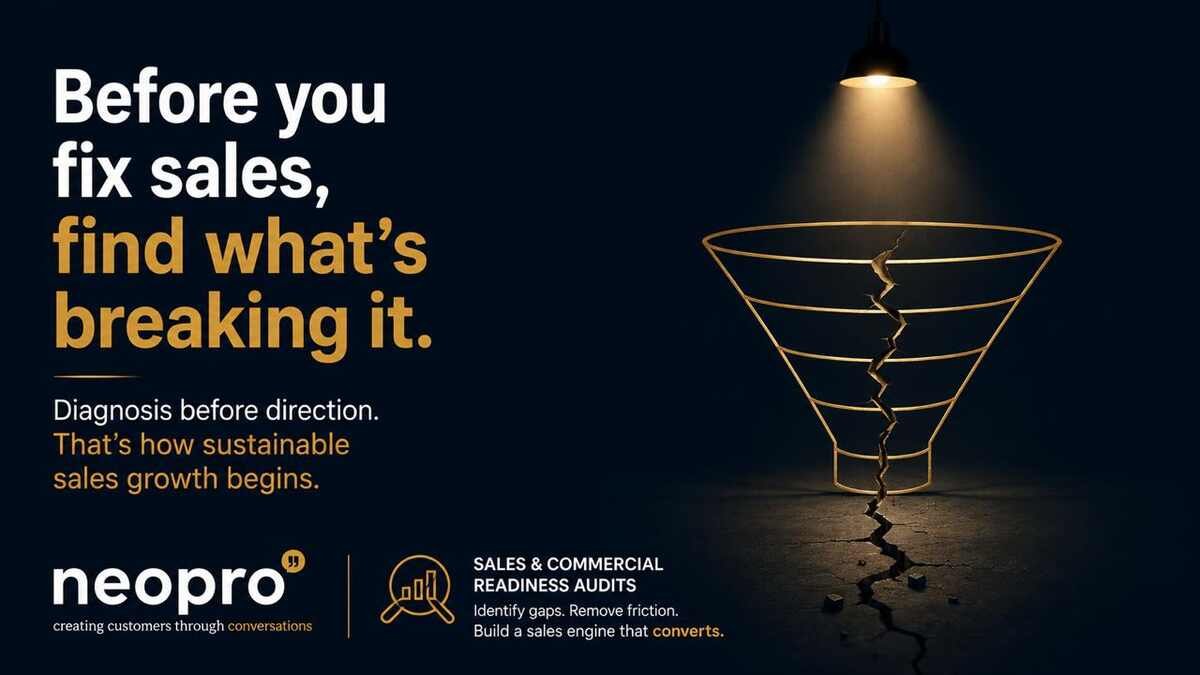
This is where the idea of a Sales & Commercial Readiness Audit becomes relevant.
Unlike traditional sales reviews that focus largely on targets and numbers, a Sales & Commercial Readiness Audit examines the broader commercial ecosystem that influences buying decisions. It looks at the alignment between sales and marketing, customer communication, lead qualification, follow-up processes, sales workflows and the overall buying experience.
The objective is not to find fault with individuals.
It is to identify structural gaps that may be quietly reducing business performance.
Perhaps the most significant benefit of such an exercise is clarity.
When business leaders understand where customers are being lost and why friction exists, decisions become more objective. Investments become more focused. Teams become better aligned. Improvements become measurable.
Growth, after all, is rarely created by working harder alone.
It is created by removing the obstacles that prevent good work from producing better outcomes.
Maybe it is time we started looking at sales differently.
Just as finance relies on audits and medicine begins with diagnosis, sales too deserves a structured process of understanding before intervention.
Because sustainable sales growth doesn’t begin with more pressure.
It begins with better diagnosis.
About the Author
Asheesh Bhimsaria is the Founder of NeoPro Sales, a sales consulting firm that helps businesses identify structural gaps across sales processes, customer communication and marketing alignment through Sales & Commercial Readiness Audits.
Website: https://www.neo-pro.in
By Asheesh Bhimsaria, Founder – NeoPro Sales